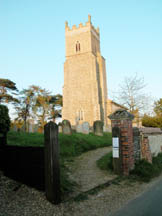
The lower part of the Nave
walls date from the late Saxon or early Norman times; and in
evidence can be seen the typical coursed flint work of that period
up to the sills of the windows on the South side; also rough
quoins of 11th/12th century work. In the perpendicular period the Nave
windows were much enlarged and the buttress added.
The Tower was
built about 1380 in the style of the Decorated period, and contains a fine
ring of 6 bells, two of which are in need of repair. There
are beautiful square cut white flints on the parapet, with much decoration.
The Chancel was largely
rebuilt about 1300, and the priest's door is typical of this
period: inside can be found the initials
of Louis Norgate the then Rector, who restored it in
1848.
The Porch
was added sometime between 1480 and 1510, and was intended
for secular use; it was poorly built, typical
of the falling standard of that age.
Its windows were blocked in the 17th or 18th Century. A niche
above the entrance was presumably meant for a statue of St Thomas.
The inner door is
a beauty, somewhere about 680 years old: its handmade key, no doubt fashioned
by a local smith, is enormous, fortunately far too big to mislay!
THE
INTERIOR
The pews here illustrate
the social gradations of a former age, with six box pews for the farmers
and their families at the front, dated about 1710, and
benches behind with poppy heads, drilled to carry pricket lights.
These date from about 1610.
There are Maid's
seats and remains of others against the wall for the maidservants of the
small farmers or tradesmen. Such examples are rare.
There is a Regency
Gallery which was added by local craftsmen to accommodate the
rising population of the village.
The Reading Desk dates
from the time of Elizabeth 1 (1558-1603) and adjacent to it is
the pulpit which dates from Queen Anne (1702-1710), contemporary with the
box pews. The Parish Clerk used to sit in the pew next to the Reading
Desk, and the desk is in its original state.
Behind the pulpit have been
found traces of an early 15th Century Chantry Chapel of St Thomas a Becket.
Here also is the former entrance to a Rood loft, filled in to strengthen
the chancel arch.
There are a few remaining
traces of the 15th Century flooring in the nave in front of the reading
desk and a few pamments in the SE corner of the nave.
The Font is 15th Century
and has on its rim the mark of hasps which kept holy water locked in pre
reformation days.
The Communion Rails with
their pillars so close together must date from the time of Charles I, when
Archbishop Laud decreed that dogs must
be kept out of the Sanctuary! The Chancel
is now used for regular worship by the congregation each
Sunday.
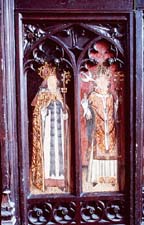
The Chancel Screen
was sawn off in Edward VI 's reign, and then at Queen Elizabeth's command
was restored in 1558 by joining it with iron straps. The loft and
rood had gone.
The above text is
copied directly from the leaflet "St Thomas Church, Foxley
-A SHORT GUIDE" to be found in the church, and the original material is
acknowledged as being the work of Richard Butler-Stoney.
THE CHURCH BELLS restored in the year 2013
The bells are back- in the tower and named after the 6
Saints of St Thomas' Church. We had a very pleasant blessing service led by
David Head, which many from the local community attended. It was also pleasing
to see the primary school children from Bawdeswell there who had taken up hand
bell ringing. They put the name labels on the 6 bells. The bell names are
Ambrose, Augustine, Gregory, Jerome, Thomas the Apostle, and Thomas a Beckett
,the martyr. We managed to get 5 bells hoisted up in the tower that afternoon.
It has taken three weeks of hard labour to do the rest of the work. Today, May
9th, these bells were rung up - the tenor having been silent since 1952 the
others pretty well since 1984. My thanks go to all the volunteers who have
worked tirelessly since January 7th. The bells await acceptance testing by
Taylors but today at 400pm each bell sounded again.
Once we are through the acceptance testing the Foxley
band will be able to ring at services and at a weekly practice at 730pm on a
Wednesday evening to 900pm. There may be other odd times when the bells are rung
during the day but we hope the village will enjoy the sound again after all this
time. When the bells have settled down we will have a dedication service to
inaugurate them. It has been a long journey, with many significant technical and
funding issues overcome through the efforts of local people, but through their
efforts we have secured a bit more of Foxley's heritage for future generations.
BACK TO
CONTENTS